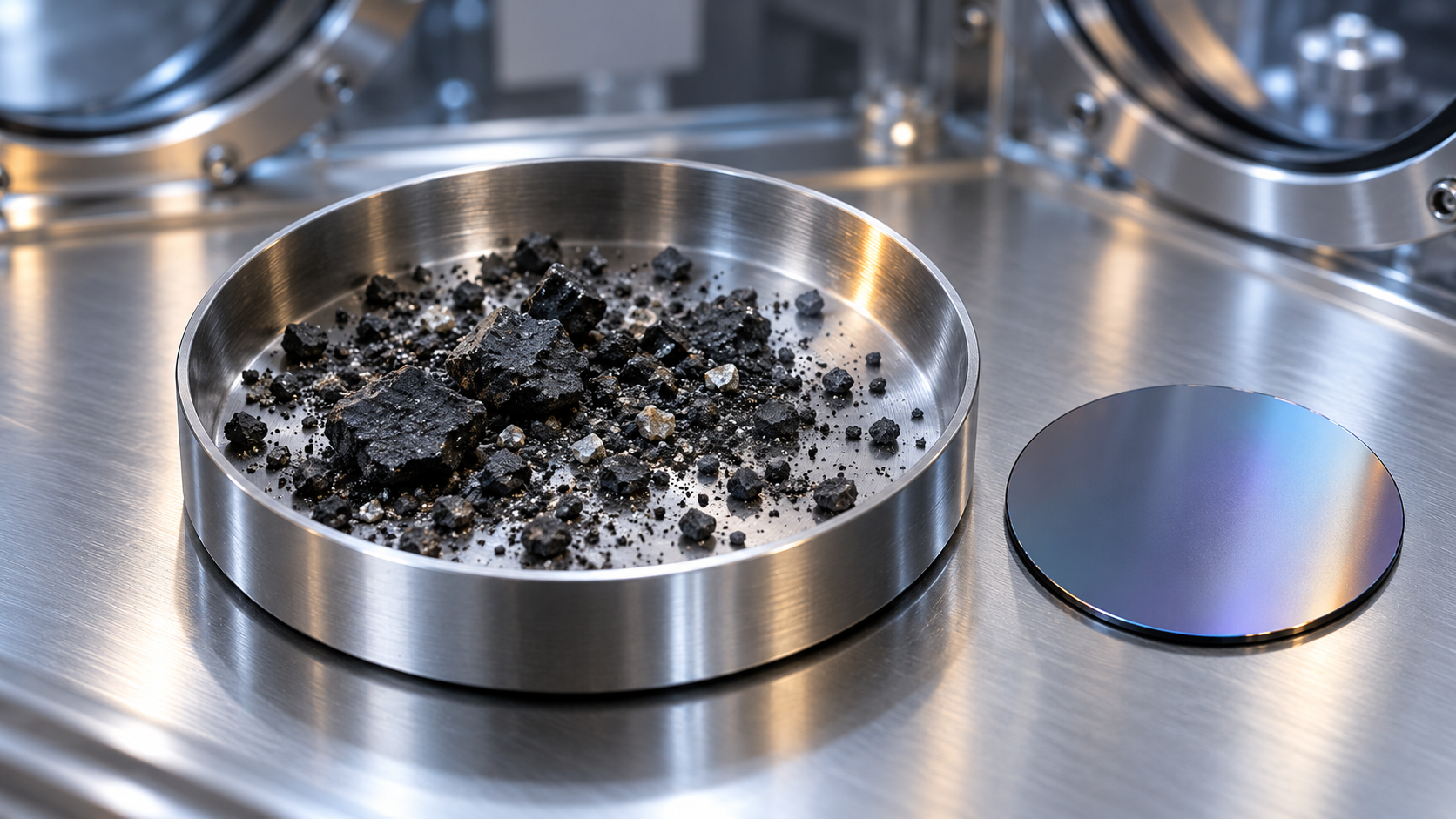
The journey of an asteroid sample does not end when its capsule reaches the ground. It continues through transfer containers, glove boxes, microscopes, sample catalogs, and laboratory blanks. That quieter journey can determine which discoveries survive long enough to be made.
Bennu's returned material makes the point unusually clearly. Its scientific value lies not only in what the grains contain, but in the documented conditions under which they reached an instrument. A dark particle without that history could still be interesting. A particle with that history can answer harder questions.
Preserve what Earth would erase
In 2025, researchers described an array of sodium-rich salt minerals in Bennu samples and interpreted them as a record of brine evolution on its parent body. The primary mineralogical study also reported a revealing preservation comparison: some salts altered or disappeared during storage exposed to air, while carefully nitrogen-stored material retained fragile phases.
This changes how to think about sample return. Returning a rock does not simply allow the same observations at higher resolution. It can preserve evidence that a meteorite's uncontrolled journey through Earth's environment might modify or remove. The absence of a mineral in a terrestrial collection may sometimes describe preservation history as well as original composition.
Imagine receiving two copies of an old letter, one kept dry and one left in rain. The rain-damaged copy is still a historical object, but a missing ink mark cannot automatically be treated as something the writer never wrote. Asteroid minerals are not ink, yet the distinction between an original absence and a later loss is the same kind of interpretive problem.
Controlled storage therefore does more than keep a collection tidy. It protects the range of questions future investigators can ask.
Know what the mission might have added
Preservation has an opposite concern: material introduced during collection, transport, or analysis. A sensitive chemical instrument can measure a compound very well and still leave its origin uncertain if the background is poorly characterized.
The OSIRIS-REx contamination program was designed before launch to limit relevant contaminants and document their possible sources. Dworkin and colleagues' strategy and implementation paper describes witness materials exposed during assembly and flight, alongside archived spacecraft materials. These records let later investigators compare a candidate sample signal with potential terrestrial contributions.
A witness material is valuable precisely because it is not the asteroid sample. It experiences a relevant environment and preserves information about that environment. A procedural blank plays a related role in laboratory analysis: it helps reveal what the handling and analytical process might contribute without the material being studied.
Neither provides an automatic yes-or-no answer about every molecule. A clean blank does not prove every possible contamination route was absent; a detected background does not prove the entire sample signal came from that background. Their power is comparative. They put numbers and chemical patterns into an argument that would otherwise rely heavily on reassurance.
A simple hypothetical example makes the issue concrete. If a rare compound appears at nearly the same level in the sample extract and the blank, the origin deserves scrutiny. If its abundance, isotope composition, and surrounding chemical distribution differ substantially from known backgrounds, the case changes. The full interpretation depends on the actual measurements, but the logic is understandable without operating a mass spectrometer.
Organic molecules are chemistry before they are biography
A companion 2025 study identified a rich set of soluble organic compounds in Bennu material, including amino acids and the five nucleobases used in terrestrial DNA and RNA. Its authors examined distributions, isotopic information, and molecular handedness when arguing for an extraterrestrial origin. The organic-matter paper also discusses a particular amino-acid excess for which laboratory contamination remained a possible explanation.
That qualified result is an example of the controls doing their job. The presence of many convincing extraterrestrial compounds does not grant every individual signal immunity from scrutiny. Different measurements within the same study can support different levels of confidence.
The language of “building blocks of life” needs comparable care. Finding a component used by biology does not identify an organism, a genetic system, or a past ecosystem. The distinction is not semantic caution attached to an otherwise complete discovery. It is the scientific difference between a set of molecules and an organized process that uses them.
Consider finding letters cut from an alphabet in a box. Their presence tells us something about the available symbols. It does not establish that a sentence was composed, still less that a particular story was told. Chemistry has mechanisms and constraints unlike language, but the example isolates the logical jump from ingredients to organization.
A catalog lets the evidence travel
JAXA's description of its Bennu curation shows how preservation and documentation continue after international allocation. It describes nitrogen-atmosphere handling, non-destructive characterization, contamination monitoring, and a catalog that records sample information. It also explains the value of comparing Bennu and Ryugu material using the same facilities and methods.
The comparison is important because an apparent difference between two asteroids might otherwise include a difference between two analytical procedures. Shared methods cannot erase all complications, but they reduce one class of ambiguity. A useful catalog similarly connects a reported result to the material actually analyzed, rather than treating all grains from an asteroid as interchangeable.
An aggregate measurement and an individual-grain measurement answer different questions. One summarizes the chosen mixture; the other can reveal variation within it. The sample's identity, preparation history, and allocation record are what allow later researchers to relate those answers. Without them, precise numbers can become detached facts.
There is also a practical reason to begin with non-destructive observations and preserve material for later work: some analyses consume or alter what they examine. Each irreversible step spends a portion of a finite scientific resource. Documentation makes that spending more useful by allowing observations made before and after the step to remain connected.
The cleanroom belongs in the story of the discovery because it shapes the evidence that discovery rests on. Bennu's grains carry a history from an ancient parent body. The mission and its laboratories add another history, one that must be controlled and recorded. The scientific achievement is keeping those histories distinguishable enough that a small amount of material can speak about both chemistry and time.
A thought worth keeping?