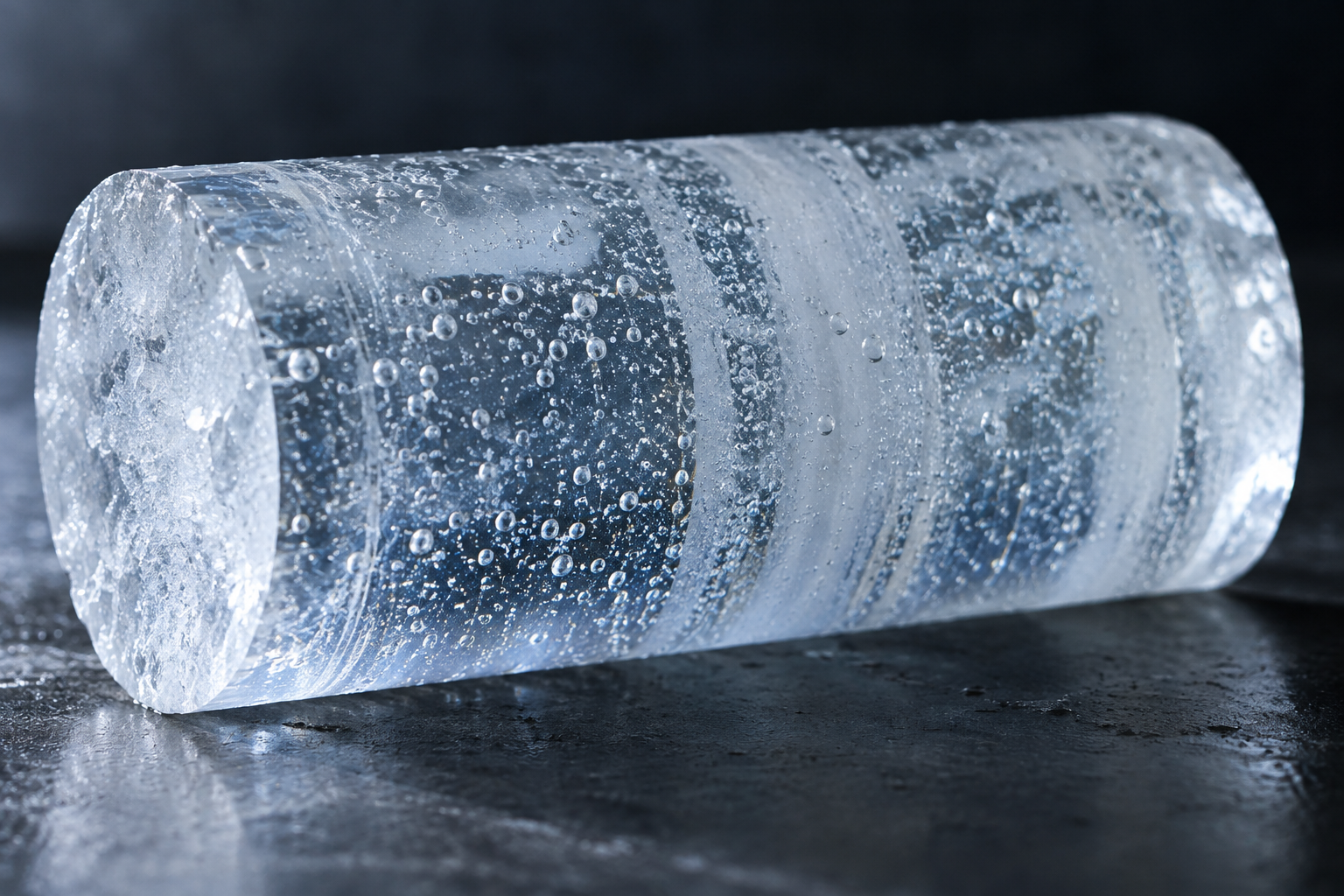
The dark specks in a slice of polar ice can be pockets of air. They invite a simple picture: snow fell, a bubble sealed, and the atmosphere of that day waited inside. The physical sample is real, but the timing is less tidy. Snow remains open to the air while it is buried and compressed. Only later do its connected pores break into separate bubbles. To read an ice core, researchers must work out both what was trapped and when it stopped exchanging with the atmosphere.
Snow is porous before it is an archive
Fresh snow is mostly space. As new snow piles on, older crystals pack and change shape, forming a porous material called firn. Air can still travel through its linked passages. Gas molecules diffuse through that network, so the air at depth is neither simply the air that surrounded the original snowfall nor a stream that can be assigned one exact arrival date. Continued burial narrows the passages. Some pores seal while others remain connected; eventually the firn becomes impermeable ice.
At Summit, Greenland, researchers sampled air from a hole through the firn and measured carbon dioxide, methane, other gases and isotopes at successive depths. Under the conditions they studied, carbon dioxide took a mean of about 12 years, with a standard deviation of 7.5 years, to diffuse from the surface to the firn–ice transition. The air became enclosed mainly between 65 and 80 metres. Those figures describe Summit, not a universal depth or travel time for polar ice. Snowfall rate and temperature change how long burial takes, and the researchers' measurements showed that closure occurred across a depth interval rather than at a single line. Summit firn study
The result is two clocks in one piece of core. The ice crystals belong to snow that fell at an earlier time. The gas often reflects a later atmosphere, after years or centuries of exchange through the firn. At Summit, the mean trapped air was about 210 years younger than the enclosing ice. That is an ice-age–gas-age difference for that site and those conditions, not a fixed correction to subtract from every core. Nor is it the same number as the gas's roughly 12-year mean diffusion time through the firn: one describes a journey through open pores; the other compares air with the older snow that became the ice around it. Summit firn study
A closing zone, not a shutter click
The moment of enclosure is spread out even within one snow layer. At an East Antarctic site called Lock-In, investigators combined measurements of density, open and closed pore volume, air content and methane with three-dimensional images of the firn. Thin layers differed in density and could close earlier or later than their neighbours. Some relatively open layers remained connected below the bulk transition and admitted younger air; denser layers could hold older gas. The team's simple trapping model predicted more enclosed air than they measured, a discrepancy they could not resolve just by invoking experimental error. That is a useful warning against treating the closure process as perfectly mapped. Lock-In gas-trapping study
Because bubbles close over a range of depths and times, the gas extracted from a small piece of ice carries a distribution of ages. A reported gas age is usually a representative age for that mixture, not the birthday of every molecule. Firn diffusion mixes neighbouring years before closure, and gradual bubble trapping mixes them again. A rapid atmospheric rise can therefore appear slower or smaller in the core. This does not make the record useless; it gives the record a time resolution that has to be estimated. In a study of the Roosevelt Island core, researchers used bubble-pressure experiments and a densification model to constrain its trapping function—the share of air sealed at different depths—and noted that ordinary laboratory gas measurements average the contents of many bubbles. Roosevelt Island bubble study
That distinction matters especially when comparing gas changes with events recorded by the ice itself. Dust, volcanic material and the water molecules in an ice layer belong to a different part of the archive from the air sealed later inside it. A proposed lead or lag between an atmospheric change and a change inferred from the ice cannot be read straight from two marks at the same depth. The separate age scales, and the width of the gas-age distribution, belong in the comparison. The bubble offers a sample of the past atmosphere; the surrounding ice supplies its own evidence and its own clock. Summit firn study Roosevelt Island bubble study
Getting the air out without rewriting it
The next problem is practical. The bubble is small, the target gases are dilute, and a drill can crack the core or expose it to modern air. Scientists keep samples cold, select suitable sections and extract gas in controlled equipment. One early Antarctic study built a dry system that crushed a kilogram of ice into fine pieces in two minutes. For the shallow Mizuho samples used in its extraction-efficiency test, the method released about 98 percent of the enclosed air. Its estimated overall precision was better than one part per million for carbon dioxide and ten parts per billion for methane. Those numbers describe that apparatus and test material; they are not automatic specifications for every core. Mizuho extraction study
The same paper offers a sharper lesson about measurement. Its dry crusher produced methane concentrations 50–200 parts per billion higher than a wet extraction system, probably because contact with the metal equipment generated methane. Melting, meanwhile, can change the carbon dioxide result. Neither a machine reading nor the word direct removes the need for blanks, standards, replicates and checks on the extraction method. A trapped sample is more direct evidence of old air than a proxy inferred from another substance, but the route from ice to a reliable number is experimental work. Mizuho extraction study
Law Dome in Antarctica provides a particularly useful test. Its high snow accumulation lets bubbles close relatively quickly, bringing the gas record close enough to the present to overlap direct atmospheric measurements. In a 1996 study, air from three cores yielded a carbon dioxide series for 1006–1978 CE; the overlap with instrument measurements reached up to 20 years. The researchers sampled the open firn above bubble closure to constrain diffusion and air age and estimated a carbon dioxide uncertainty of 1.2 parts per million, one standard deviation. Agreement at the overlap is a test of the method across that interval. It does not mean every older core has Law Dome's resolution. Law Dome carbon dioxide study
Even a careful published series can improve. A later Law Dome reassessment added measurements, revised the gas-age scales using updated ice ages and a firn diffusion model, and adjusted selections and corrections for extraction, gravity and diffusion. Those revisions show what a rigorous archive looks like in practice: a measured gas concentration, an age estimate and a record of the choices that connect them. The authors also reported unresolved differences among some ice-core and firn-air records. The uncertainties are discussed and worked on, rather than hidden by the appealing image of a perfect sealed capsule. Revised Law Dome records
The reach of the method is immense. In 2008, measurements from the lower 200 metres of the EPICA Dome C core extended a composite Antarctic carbon dioxide record back to about 800,000 years, across eight glacial cycles. That long span and Law Dome's recent overlap answer different questions: one follows broad atmospheric changes through many climates; the other tests a fine-grained transition into instrumental observations. Both depend on knowing what happened to the air before it was sealed. Dome C carbon dioxide study
A bubble, then, records old air with a physical directness that few archives can match. Its meaning comes from the less visible material above it: the firn that allowed air to move, the uneven closing of pores, and the laboratory procedure that released a minute sample without losing track of its origin. The dark speck is the beginning of the evidence. The careful account of its age is what makes the evidence legible.
A thought worth keeping?