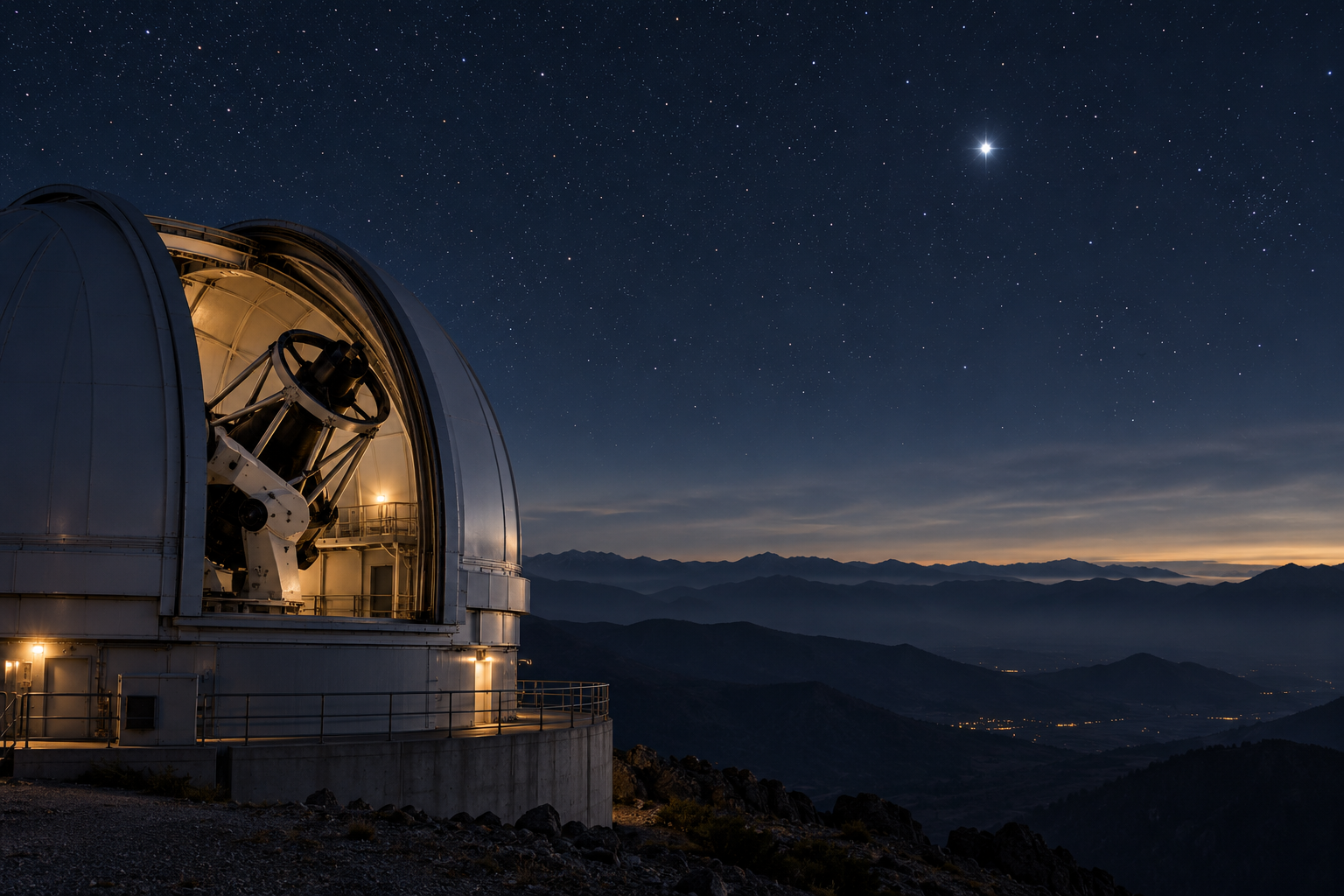
A star is small enough in a telescope image to serve as a test of the telescope itself. In a perfect instrument above the atmosphere, its light would gather into a compact pattern set by diffraction. At the ground, the point often trembles, spreads, and changes brightness. The star has not acquired a wavering edge on its journey. The last part of that journey runs through moving air.
The air can look perfectly clear and still be uneven as an optical medium. Temperature and pressure differences change its refractive index: the speed and direction of light alter slightly from one patch to the next. Wind carries the patches across the telescope's line of sight. The image arriving at the detector is therefore a record of the sky and of the atmosphere during the exposure.
A point of light, repeatedly displaced
Light from a distant star reaches Earth as an almost flat wavefront. A calm, uniform path would preserve its shape. Turbulent layers make some parts of the wavefront arrive ahead of others. Across a large telescope mirror, the distortion is uneven; the instrument gathers light from many slightly different paths at once. The resulting star image can jump, break into fleeting speckles, and spread into a larger patch when the camera collects light over time.
David Fried's 1966 analysis of optical resolution through a randomly inhomogeneous medium distinguished very short from very long exposures. A short exposure can sometimes retain finer detail than a long one, which averages many successive distortions, though Fried also showed that strong intensity variation limits that advantage. The point is subtle: making an exposure longer gathers more light, but it also gathers more versions of a shifting image.
Astronomers call the turbulence-limited sharpness of a ground observation seeing. It is not the same thing as the measured width of every image a telescope produces. The European Southern Observatory's observing guidance separates seeing, a property of atmospheric turbulence, from image quality at an instrument's focal plane. That measured image also depends on wavelength, how high the target sits in the sky, and the telescope and instrument. This is why an observatory schedules demanding observations for particular conditions rather than treating a clear sky as a complete guarantee of sharpness.
Why the eye sees a twinkle
The blur in a photograph and the flicker seen by an eye have a common turbulent cause, but they describe different things. Scintillation is a fluctuation in the amount of starlight reaching a detector. As distorted bundles of light move past a small pupil, the star seems to brighten and dim. In a 1967 study of aperture averaging, Fried modeled how a larger aperture reduces the variance of those intensity fluctuations. A telescope can therefore collect a steadier total signal even while its unresolved star image remains blurred by changing wavefronts. Less visible twinkle does not mean the atmosphere has ceased to affect the image.
The atmosphere also bends starlight in a more orderly way. Its refractive index varies with height, so a star appears displaced from its position outside the atmosphere, especially low in the sky where the light takes a slanting path through more air. Because the bending differs by wavelength, blue and red light need not fall at exactly the same place on a detector. ESO's differential-refraction calculation for La Silla explicitly includes wavelength, zenith distance, pressure, temperature, and humidity. Refraction must be planned for and calibrated; it is not the same fast, random disturbance that gives seeing its restless character.
A mirror that changes while the sky is open
Adaptive optics tackles the changing wavefront directly. A sensor measures distortions in light from a suitable reference source. A computer then commands a deformable mirror to add an opposing distortion before the light reaches the science camera. The cycle repeats quickly because the relevant air changes on short timescales.
This is an observed technique, not a promise that a sharper image might someday be possible. In October 1989, an ESO-led prototype used a mirror with 19 actuators and updated its correction 100 times a second. Tests at the 1.52-meter telescope in Haute-Provence compared infrared images with and without correction. At wavelengths of 3.5 micrometers and longer, the corrected images reached the telescope's diffraction limit in those tests; at 2.2 micrometers they often did. The result was tied to the tested bright stars and infrared bands, where correction is easier than at shorter visible wavelengths.
A reference star must be close enough to sample much the same disturbed air as the target. If a suitable natural star is missing, a laser can excite sodium high in the atmosphere to make an artificial point of light for the wavefront sensor. ESO's four-laser facility reached first light in April 2016. The four beacons were built to feed adaptive-optics systems on the Very Large Telescope. ESO's later account explains that several lasers help characterize turbulence at different heights and extend the field over which correction is useful.
The mirror still has limits. It must infer a changing distortion from finite light, react before the air changes again, and correct a region of sky whose turbulence may differ from that around the guide star. Keck Observatory describes its own deformable mirror as adjusting hundreds of times per second, even at a site chosen for unusually stable air. Adaptive optics makes particular observations much sharper; it does not turn a mountain telescope into one above the atmosphere.
What reaches the mirror is starlight reshaped by air. That moving layer can shift a color, spread a point into a blur, or make a steady source seem to pulse. Astronomers measure those effects separately because each asks for a different response: a better observing window, a refraction correction, a shorter exposure, or a mirror fast enough to follow the air.
A thought worth keeping?