A blue ocean beneath white ice looks persuasive in a cutaway illustration. It is also a drawing of a conclusion, not a photograph. No camera has looked through Europa's shell and recorded a sea. Understanding why scientists nevertheless take that sea seriously requires separating several observations that artists naturally combine into one scene.
That separation makes Europa more interesting. The question is not whether researchers have somehow forgotten to take a direct picture. It is how much information a world can disclose through the different ways it responds to its surroundings—and which properties remain entangled after those responses are measured.
A magnetic response is a physical clue
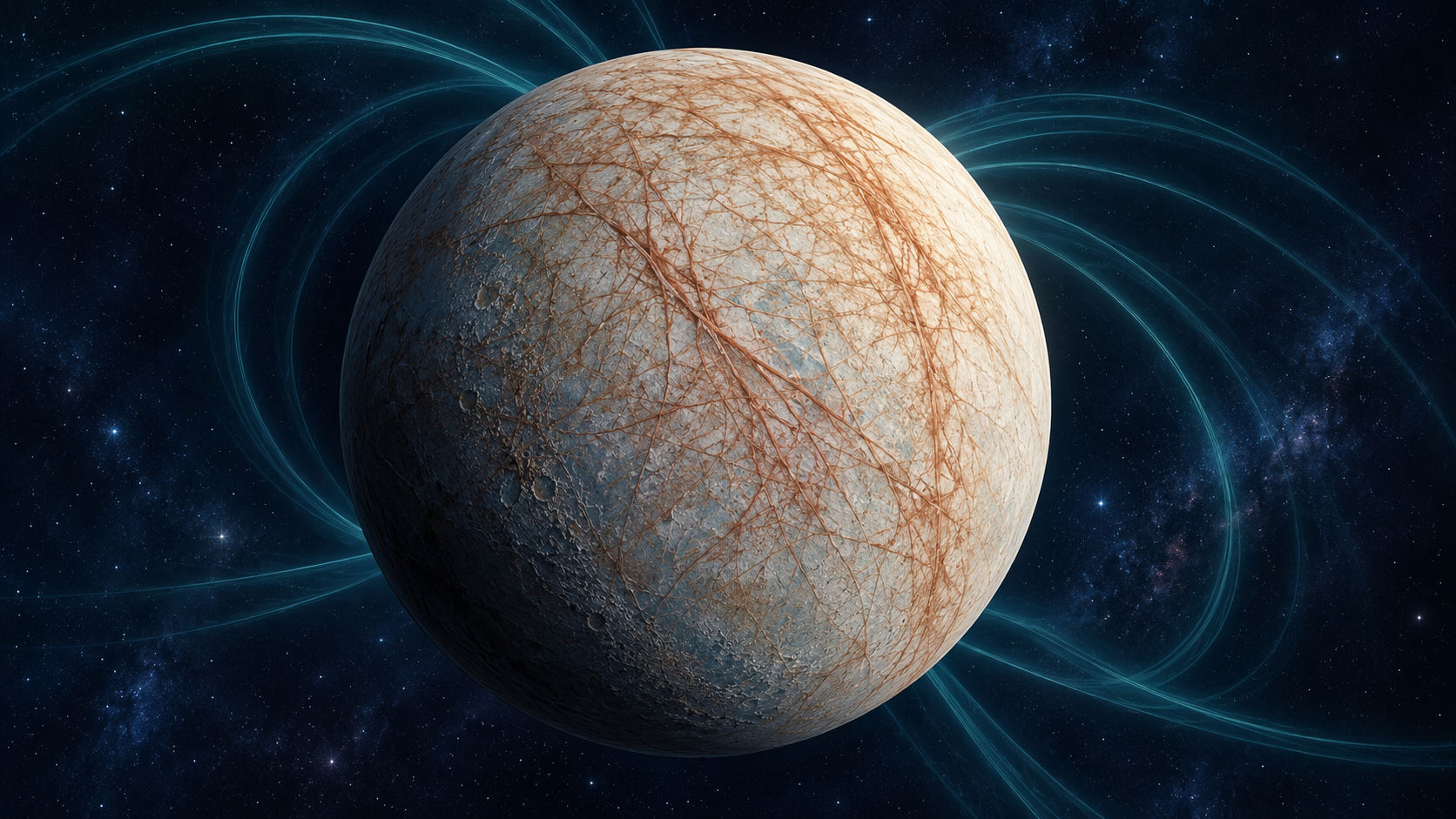
Galileo measured disturbances in Jupiter's magnetic field near Europa. A conducting layer beneath the surface provides a compelling explanation: a changing external magnetic field drives electric currents, and those currents produce their own field. Given Europa's icy composition, a global layer of salty liquid water is the leading interpretation. NASA places this magnetic evidence alongside the moon's fractured, relatively young surface in its account of the case for an ocean.
Notice the intermediate term: conducting. The instrument measures a magnetic field. Researchers infer electrical behavior and then evaluate materials and internal arrangements that could produce it. Water enters the argument with composition, temperature, geology, and physical models; the magnetometer does not chemically identify seawater.
This is not a weakness unique to distant moons. A medical scan, a seismic section, and an electrical survey also translate a measured response into properties of something inaccessible. The useful question is whether plausible alternatives make distinguishable predictions. An inference becomes stronger when different kinds of evidence eliminate different alternatives, rather than when one attractive image is reproduced often.
Ice thickness needs more than one ruler
Imagine two sealed containers responding similarly to an external electrical experiment. One has a thinner conducting layer with one conductivity; the other has a thicker layer with another. Without additional information, a response can constrain a combination of properties more tightly than each property separately. This is a conceptual example, not a numerical model of Europa, but it explains why “there is probably an ocean” and “we know the thickness of the ice” are very different statements.
Europa Clipper's design addresses that distinction. Its magnetometer works with a plasma instrument because charged particles around Jupiter also affect the magnetic measurements. Its radio tracking supports gravity science, while imaging and thermal observations examine surface structure and activity. The mission's science documentation describes these investigations as interdependent.
An independent measurement is valuable because it can cut across a tradeoff. If one observation permits several combinations of shell thickness and ocean properties, a second observation may rule out some of those combinations. Adding instruments is not simply adding votes. Their greatest contribution is often that they are sensitive to different things and fail in different ways.
Radar listens for boundaries
REASON, Clipper's ice-penetrating radar, transmits radio signals and measures returning echoes. Travel time helps locate a reflecting boundary; returned energy contains information about the materials and the signal's passage through them. The instrument uses two frequency ranges and is designed to investigate structures within the shell, including possible water bodies. NASA describes penetration of as much as 30 kilometers as a capability, not a promise that every track will reveal an ocean floor beneath the ice. The REASON instrument explanation makes clear that material properties and wavelength govern what passes through and what returns.
An echo can therefore be informative without reaching the deepest target. Internal layers could reveal how ice deforms or accumulates. A shallow reservoir, if identified, would pose questions about local melting and exchange. Conversely, a missing basal echo would need to be interpreted with signal loss, the shell's structure, and the observing geometry in mind. “We did not receive an echo from the ocean” would not, by itself, mean “there is no ocean.”
There is a useful everyday distinction here between an object being absent and a measurement being unable to resolve it. A telescope that cannot separate two close stars has not established that only one exists. Keeping those possibilities apart is the work of instrument interpretation, not a rhetorical escape after an inconvenient result.
The harder question is exchange
Even an exact measurement of ocean volume would leave a central habitability question open. Life needs usable energy and suitable chemistry, not simply a large supply of liquid. A sea isolated from both surface products and reactive rock presents a different environment from one that receives material from both.
Clipper's science plan consequently asks how the ice, surface, and interior interact. It discusses potential chemical energy from water–rock reactions and from radiation-altered surface compounds, while explicitly distinguishing an investigation of habitability from life detection. These are questions the mission is designed to test, rather than an inventory of a confirmed ecosystem.
Think of a pantry containing all the ingredients for bread. Their presence does not establish that they are mixed, heated, or replenished. The analogy is limited—an ocean is not a kitchen—but it isolates the logical step that popular descriptions often skip. Ingredients, access, rates, and persistence are separate conditions. Knowing one does not automatically supply the others.
For Europa, that means a mapped fracture could matter without being a pipeline to the ocean. A chemical on the surface could matter without having originated below. A warm patch could matter without indicating a lasting, globally important exchange route. The task is to connect these observations through mechanisms that survive comparison with the rest of the data.
A responsible picture of Europa should therefore retain some unfinished edges. The ocean is a well-supported inference; the thickness, chemistry, connectivity, and energy supply require more work. Future observations may sharpen some answers while revealing new disagreements. That would be progress. A moon understood through several imperfect measurements is more scientifically substantial than a flawless cutaway whose blue interior quietly conceals everything still unknown.
A thought worth keeping?