Before asking what an exoplanet's atmosphere contains, ask which part of its star supplied the light. It sounds like a detour. For small planets crossing active red dwarfs, it can determine whether an apparent molecular signal belongs to a planet at all.
Transmission spectroscopy is an ingenious comparison. A telescope measures a system during a transit and outside it, wavelength by wavelength. If a planetary atmosphere absorbs some wavelengths more strongly than others, the planet can appear larger at those wavelengths. But the comparison also depends on how the star's own light is distributed across its disk.
The denominator has a surface
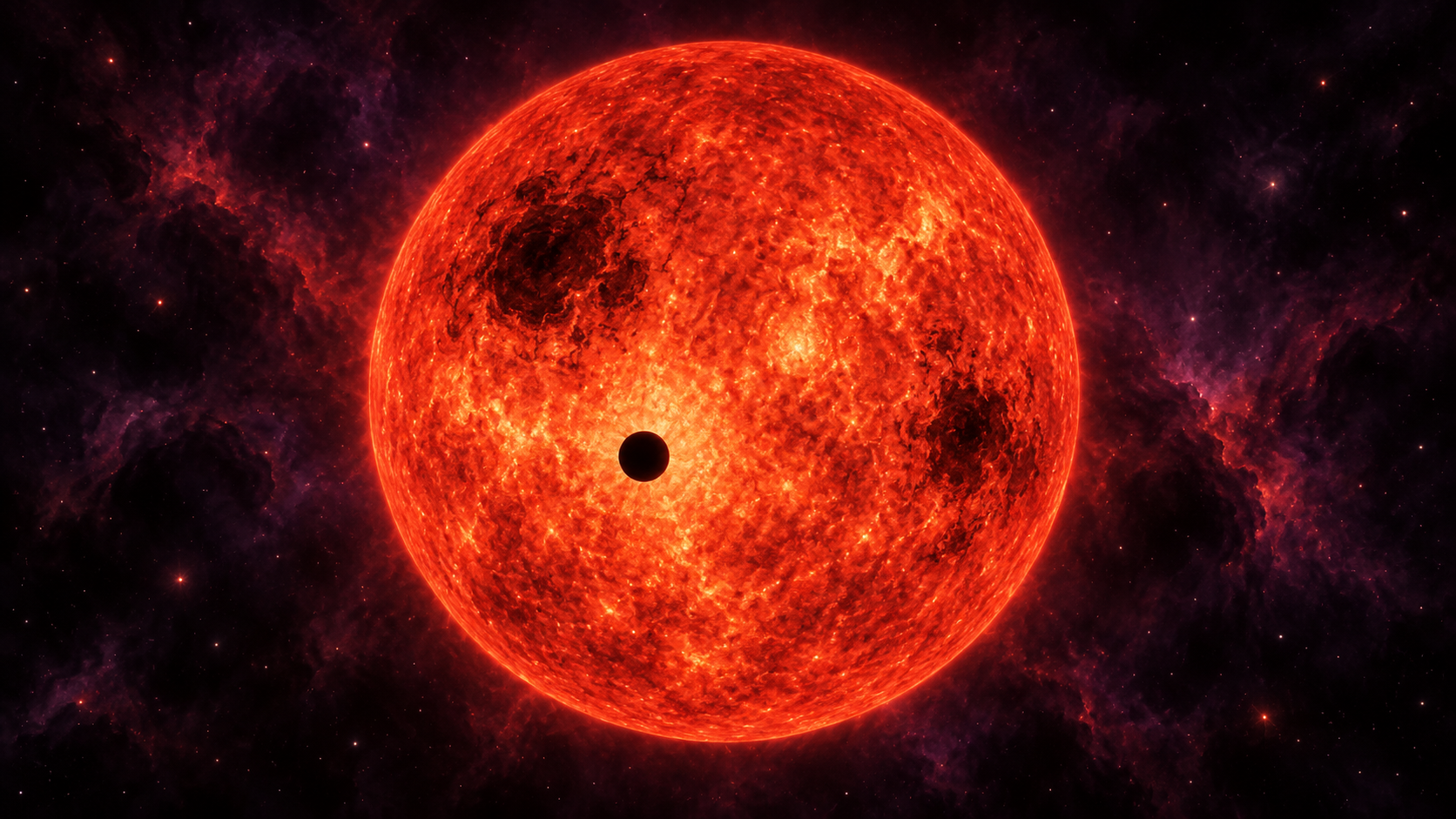
For a uniformly bright disk and an opaque planet, a simplified transit depth is the planet's projected area divided by the star's projected area. Real analyses include additional effects, but this starting point is enough to expose the stellar problem: the star is not a uniform lamp.
Suppose, in a deliberately artificial example, a planet blocks a patch producing one unit of light while the visible stellar disk produces a hundred units. The fractional loss is one percent. If a darker region elsewhere reduces the disk's total to ninety units while the blocked patch stays the same, the loss becomes about 1.11 percent. The planet has not grown. The reference light has changed.
Now allow the darker region's spectrum to differ with wavelength. A wavelength-dependent change in the fractional loss can appear even without a wavelength-dependent planetary atmosphere. This is the conceptual basis of contamination by unocculted stellar features: a spot need not be directly crossed by the planet to affect the inferred spectrum.
The 2023 observations of GJ 486 b offered a concrete illustration. A signal consistent with water vapor could be explained either by a planetary atmosphere or by cool regions on the host star. NASA's report on the competing interpretations explicitly notes that the absence of an observed spot crossing does not exclude spots elsewhere on the star.
A genuine molecule can have the wrong address
There is a subtle but important distinction between misidentifying a molecule and mislocating it. A feature might be consistent with water absorption while its physical source remains unresolved. Calling it a planetary water detection would skip the second question.
Nor does the word water, by itself, describe an ocean, a habitable surface, or life. Gas at a starspot and gas around a hot rocky planet occupy radically different environments. Even a firmly established planetary water-vapor signal would need to be interpreted with temperature, pressure, atmospheric structure, and the rest of the spectrum.
This is why the familiar metaphor of a molecular fingerprint can mislead if carried too far. A recognizable fingerprint still needs a chain of reasoning connecting it to the object under investigation. In a transit observation, light from the star, any planet atmosphere, and the observing system are combined. The challenge is to identify which contribution produced each part of the measured pattern.
Repetition is useful when the star changes
Two transits need not produce identical stellar contamination. The star rotates, its visible surface changes, and active regions evolve. Those differences are obstacles to averaging blindly, but they also provide information that a single visit cannot supply.
Lim and colleagues' 2023 NIRISS study of TRAPPIST-1 b compared two visits with notably different transmission spectra. Their modeling supported strong stellar contributions, with different types of surface heterogeneity favored in the two visits. The study could reject cloud-free hydrogen-rich atmosphere scenarios while remaining unable to establish or exclude certain secondary atmospheres from those transmission observations alone.
That is a richer outcome than either “an atmosphere was found” or “there is no atmosphere.” A dataset can exclude one family of models and leave another family unresolved. Scientific progress often consists of shrinking the space of plausible explanations rather than selecting a single completed world.
Imagine sorting colored glass beads through a filter that reliably removes large blue beads but cannot distinguish small clear beads from empty spaces. Reporting that no large blue beads remain would be justified. Reporting that the container is empty would not. The analogy is deliberately simple; its purpose is to preserve the scope of an exclusion.
A correction is also a model
It is tempting to describe stellar contamination as a layer that can simply be subtracted. In practice, a correction depends on assumptions about the star's components, their spectra, and their relative contributions. If the stellar models are imperfect, a precise telescope can expose those imperfections rather than bypass them.
The TRAPPIST-1 b study discusses this lack of stellar-model fidelity, including the limits of interpreting fitted spot and facula parameters as a literal description of the star. A good fit is not automatically a unique surface map. More observations can help, but model uncertainty needs attention as well as measurement noise.
This suggests a useful standard for reading a strong atmospheric claim. Ask whether the analysis tested plausible stellar explanations, whether the proposed molecule appears through multiple diagnostic features, and whether repeated visits behave consistently with the interpretation. Also ask which alternative atmospheres were actually considered. A claim can only be as broad as the comparisons that support it.
Several observing geometries tell different stories
A transit is one way to study a planet. A secondary eclipse measures the change when the planet passes behind its star; a phase curve tracks changing light across the orbit. These measurements constrain different aspects of a system and have their own assumptions. NASA's TRAPPIST-1 science explainer describes these complementary approaches and the continuing challenge posed by stellar activity.
The value of combining methods is not that one makes every ambiguity disappear. It is that an explanation has to satisfy several physically different observations. A model built to explain a transmission feature may face additional constraints from emitted light and heat redistribution. Agreement across those constraints is more informative than repeatedly fitting the same signal.
Distant planets remain compelling precisely because the information is so sparse and the measurements so demanding. A small change in starlight can disclose something about an atmosphere many light-years away. Getting there means treating the star as part of the experiment: an active physical object whose uneven light has to be understood before the planet's own contribution can be named.
A thought worth keeping?