A small lunar rock can change the estimated age of a landscape that no spacecraft has sampled. It can even influence how researchers date surfaces elsewhere in the inner Solar System. The reason is that crater counting needs a clock calibration, and a returned sample can supply one of its rare anchors.
The popular version of the method is appealingly simple: more craters mean an older surface. The practical version asks which craters, on which geological unit, formed at what rate, and since which event. Those questions turn counting circles into planetary history.
A crater count measures a population
Imagine two identical trays left beneath a steady shower of falling beads. If beads remain where they land, the tray exposed longer should collect more. With a known arrival rate, the count can estimate exposure time.
Now change the experiment. Let the shower become much heavier at the beginning. Occasionally clear part of a tray. Let one incoming bead knock several others into neighboring patches. The number remaining still contains information about exposure, but it is no longer a simple stopwatch. The history of arrival, removal, and redistribution has entered the calculation.
These are conceptual experiments, not models of lunar impacts. They help distinguish the observed quantity—a size-dependent crater population per area—from the age inferred through a chronology model. Counting more carefully improves one part of the estimate. It does not independently establish the historical rate at which craters accumulated.
There is also a basic statistical reason to care about the area surveyed. In an invented example, finding two large craters on one small patch provides less stable information about a regional density than counting hundreds over a comparable, well-defined geological unit. A single additional crater would change the first count by half. It would barely affect the second. The map boundary and diameter threshold are therefore part of the scientific result.
The samples connect the count to years
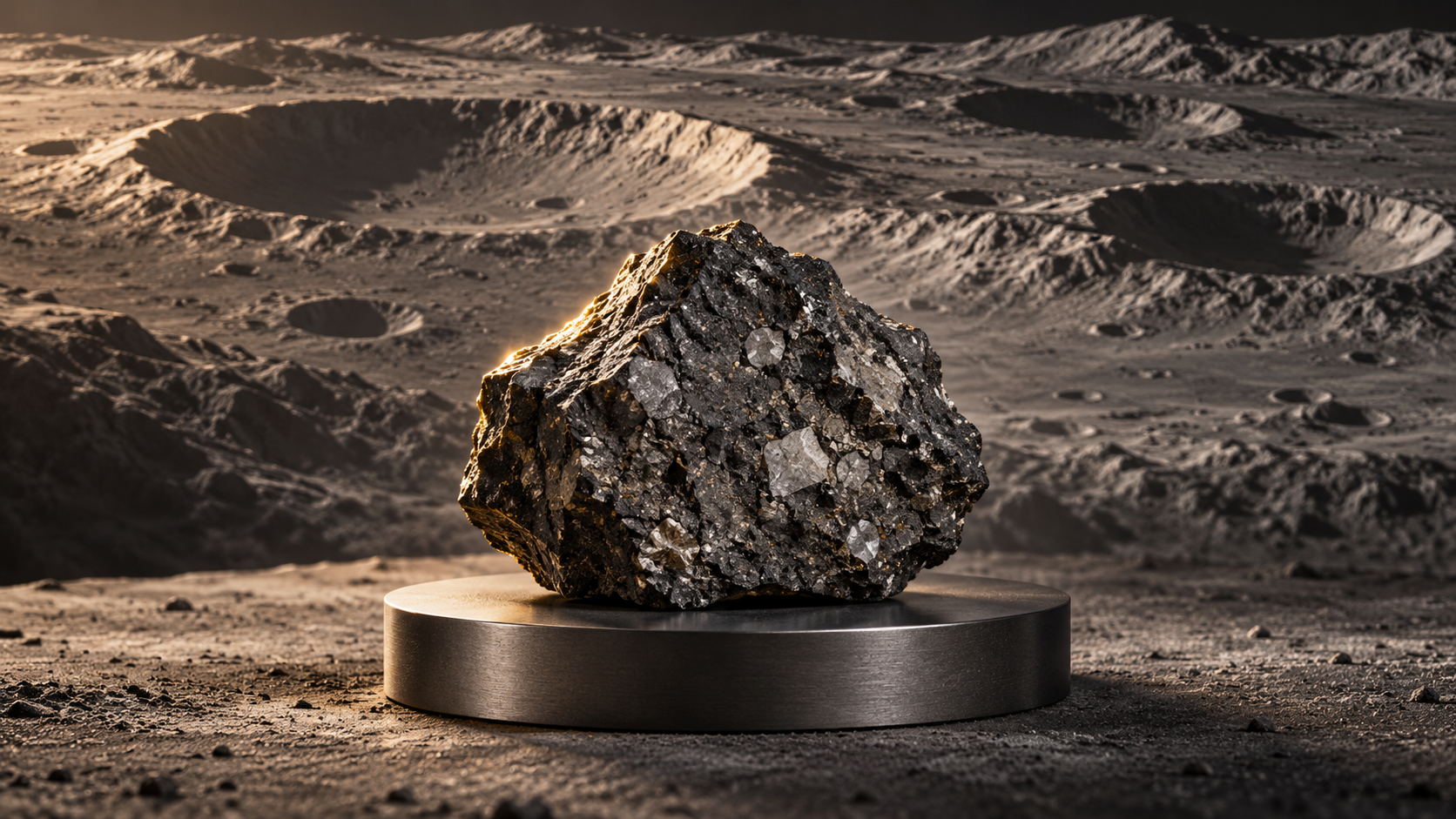
Lunar chronology has been calibrated by associating laboratory ages of returned samples with crater populations at their source regions. But the available samples did not cover every time interval evenly. Chang'e-5 returned basalt from a region that helped fill a major gap.
Li and colleagues reported a crystallization age of 2,030 ± 4 million years for basalt clasts in their 2021 study of the Chang'e-5 material. Their analysis also discusses why the returned clasts could be linked to the mare unit at the landing site. That connection is essential: a precise laboratory age calibrates a surface only if the dated material represents the relevant unit and event.
This is where two very different scientific operations meet. Laboratory dating interrogates minerals. Orbital mapping identifies geological relationships and crater distributions. An excellent result from either operation cannot substitute for the argument joining them.
A rock thrown into a younger deposit from an older neighboring area illustrates the issue. Its crystallization age would not date the deposit simply because it was collected there. Conversely, a dated basalt demonstrably associated with a mapped flow can provide a powerful reference. Context makes the numerical age geographically meaningful.
Recalibrating changes more than one place
Yue and colleagues used the new age to update lunar chronology models. Their 2022 model study reports that the resulting ages differ from the widely used Neukum chronology, with a maximum difference of 0.24 billion years in their comparison. This is a reported result for that model, not a universal correction that should be added to every published lunar age.
The broader lesson is that an improved anchor can change the curve between anchors. When a conversion is shared across many studies, one well-contextualized sample can have consequences far beyond its collection site. That is one reason sample-return missions have scientific value disproportionate to the mass they bring home.
The ±4 million years attached to the rock also should not be copied onto every crater-derived surface age. The laboratory uncertainty is one part of a larger inference. The crater count, geological assignment, model form, and transfer to a different region introduce their own uncertainty. A very precise calibration point does not make the entire calibrated system equally precise.
Watch the clock running today
New impacts offer a complementary test. Lunar Reconnaissance Orbiter observations have compared images of the same areas at different times, identifying craters that formed between observations. NASA's report on the 2016 LROC analysis describes more than 200 newly formed craters and a contemporary small-crater rate exceeding the expectation used in that study.
This is direct evidence of present-day change, valuable for studying the recent end of the chronology. It does not provide a time machine to the early Moon. A rate measured over years and for a particular crater-size range must not be extrapolated across billions of years without a model supporting that extrapolation.
The same observations revealed many smaller surface disturbances associated with impact debris. One primary impact can therefore produce a wider pattern of change. Separating primary impacts from effects of ejecta matters whenever a count is being used as a record of independent incoming objects.
The LROC findings summarized by NASA also show why the upper lunar surface should not be imagined as an untouched museum floor. It is continually modified. Which traces survive depends on scale and process, even in the absence of terrestrial weather.
Ask which event the age describes
A planet, a rock, a lava flow, and a later surface modification can all have different ages. A sparse crater population may concern the exposure or resurfacing history of a particular unit; it is not the age of the Moon itself. A crystallization age records the history of a mineral system under an interpretation of its formation and later alteration.
Keeping those targets explicit prevents an ordinary numerical statement from becoming an extraordinary but false one. “These basalts crystallized about two billion years ago” says something striking about lunar volcanism. It does not mean the Moon formed two billion years ago, nor does it establish that all lunar volcanism ended at precisely that time.
The crater clock is powerful because so much of planetary exploration depends on remote observations. Its strength comes from the patient connection of images, geological context, laboratory measurements, and statistical models. The little rock matters because it helps check that connection—and because checking a clock can change the history read from it.
A thought worth keeping?