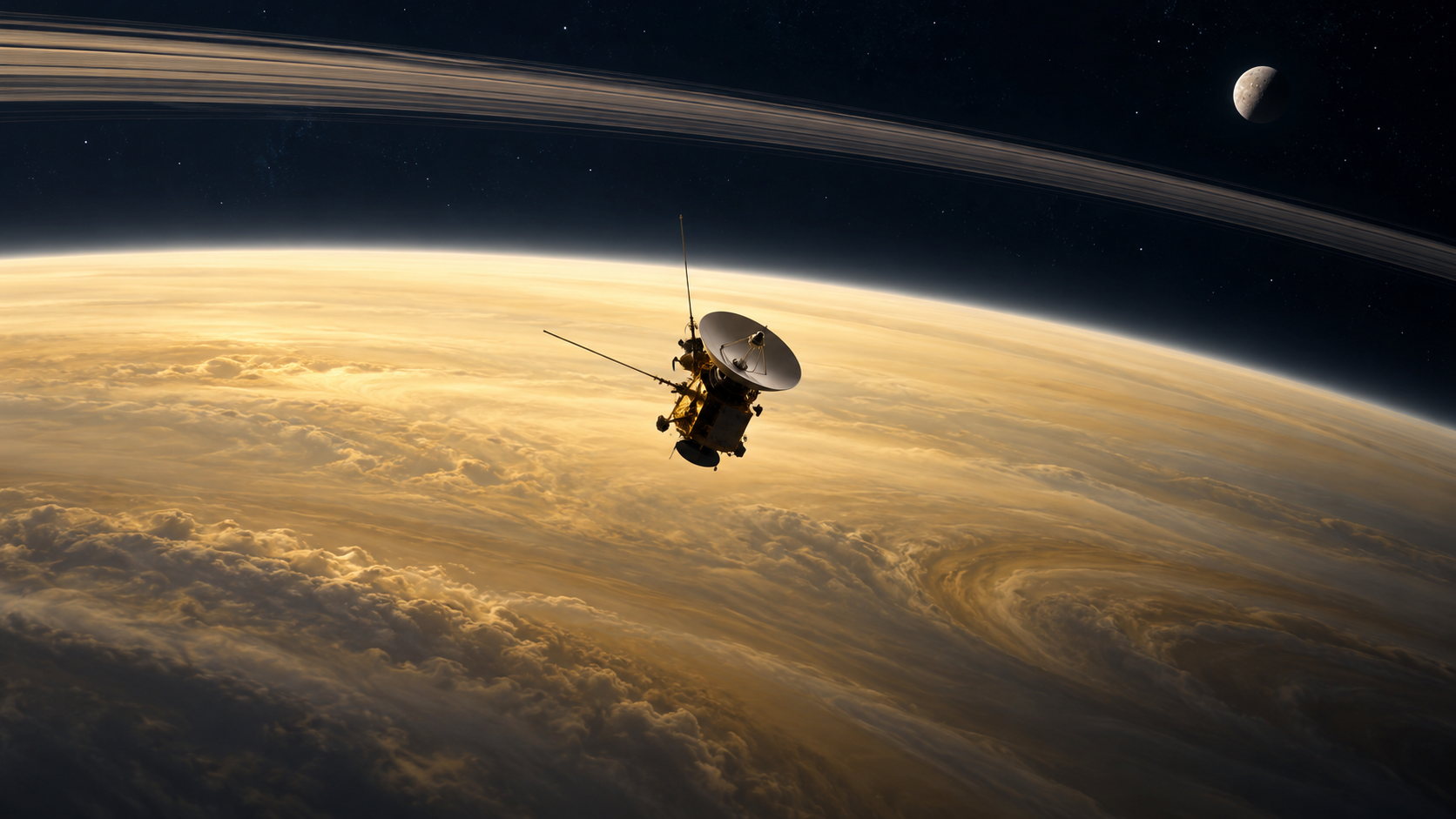
On September 15, 2017, Cassini entered Saturn's atmosphere and stopped transmitting. The end was deliberate. A spacecraft that had transformed knowledge of Saturn's moons was directed into the planet partly to protect the possibility of learning more about those moons later.
NASA's account of the Grand Finale explains the choice: as propellant ran low, eventually losing control would leave an unwanted possibility of collision with a moon such as Enceladus or Titan. Ending the mission on a controlled trajectory helped preserve those worlds for future investigation.
There is a larger idea in that ending. Exploration can consume evidence as well as collect it. Planetary protection is one way of treating an unanswered scientific question as something worth keeping answerable.
A future result needs a distinguishable origin
Suppose a hypothetical mission detects an organic compound at a landing site. Several explanations might deserve consideration: local non-biological chemistry, a process involving indigenous life, material delivered naturally from elsewhere, or a contribution from the spacecraft. The value of the measurement depends partly on how well these explanations can be separated.
If the mission has poorly documented its own biological and chemical cargo, it has made one alternative harder to evaluate. Greater instrument sensitivity does not repair missing provenance. It may make the problem more acute by revealing smaller traces of material whose history is unclear.
JPL's description of planetary-protection implementation connects contamination control to the integrity of exploration. It describes cleaning, assessment of microorganisms, controlled assembly environments, and measures against recontamination. These are parts of an evidence-preservation process, as well as spacecraft operations.
The most interesting implication is that the process protects negative results too. A sample altered by terrestrial material may lose diagnostic features or become more difficult to interpret even if no spectacular false-positive claim follows. A scientifically useful absence requires confidence that the investigation had a fair chance of preserving and detecting what it sought.
Think of an archaeological layer excavated with tools carrying modern residues. The problem is not only that a modern object might be mistaken for an ancient one. The work can also disturb relationships among genuine ancient materials. The planetary setting differs profoundly, but the principle that context is finite and vulnerable remains useful.
A cleanroom is an observed environment
The name cleanroom can suggest a place containing nothing except the intended hardware. In practice, cleanliness is controlled, measured, and maintained. People, air, incoming parts, and repeated operations create opportunities for material to enter. The relevant scientific achievement is reducing and understanding those contributions.
ESA's report on microbial monitoring describes air sampling, surface sampling, culture-based assessment, genetic characterization, and preservation of selected isolates for further research. It also describes microbes found in highly controlled facilities. The report is a historical account of those activities, rather than a statement that every current mission uses an identical protocol.
Finding microorganisms in a cleanroom does not demonstrate that those organisms survived a flight, reached a target, or could grow there. Each of those steps is another question. Conversely, an environment's low microbial abundance does not make its remaining organisms irrelevant. Scientific interpretation needs the chain of conditions connecting presence to transport, survival, access, and possible activity.
This is a good place to resist dramatic shorthand. “Earth microbe found in spacecraft facility” and “another world contaminated” are not interchangeable findings. The first can motivate controls and research without establishing the second. Careful monitoring is meaningful precisely because it can discriminate among those stages.
Some payload capacity belongs to the controls
Perseverance carried 43 sample tubes, including five witness tubes designed to capture information about possible molecular and particulate contamination during operations. NASA's explanation of the tube system describes both their extreme cleanliness requirements and the purpose of those controls. Its discussion of future return schedules reflects planning at the time of publication; the witness-tube design is the relevant point here.
A witness tube does not add another geological specimen in the ordinary sense. It adds evidence about the conditions under which other specimens were collected. That can make the geological material more valuable. In a mission constrained by mass, volume, and mechanical complexity, allocating capacity to controls is a concrete expression of scientific priorities.
Imagine an experiment with room for ten containers. Filling all ten with samples might look maximally productive. Yet if a contaminant appears and no control exists, ambiguity could affect every container. Reserving one for a well-designed control might produce fewer nominal specimens and more interpretable evidence. The actual design choices in a space mission are much more complex, but the tradeoff is recognizable.
Controls are not an admission that the engineering has failed. They are a way to test what the engineering accomplished under real conditions. A claim of cleanliness without such evidence is weaker than a documented background that can be incorporated into interpretation.
The end of a mission belongs in its beginning
Cassini shows that contamination concerns can influence trajectory and disposal, not only pre-launch cleaning. Planning for an orderly end preserves choices while the spacecraft can still execute them. Waiting until a vehicle is uncontrollable changes the problem from managing an action to estimating the consequences of a lost opportunity.
This does not imply that every world requires identical treatment, or that all scientific questions impose the same constraints. A dry surface survey, a search for organic chemistry, and an investigation of a potentially habitable environment place different demands on mission design. The reasoning should stay tied to the target, the measurement, and the ways exploration might compromise them.
There is an ethical judgment alongside the technical work: uncertainty about a place can be a reason to preserve options for future inquiry. One need not claim that life has been found, or that a particular Earth organism could thrive there, to recognize the value of avoiding unnecessary ambiguity.
A mission's legacy includes the data it transmits and the questions it leaves intact. Cassini collected information during its final approach while ending on a path chosen to protect future investigations. That is an unusually vivid example of scientific restraint serving scientific ambition: learning as much as possible while taking care that the next question can still have a meaningful answer.
A thought worth keeping?